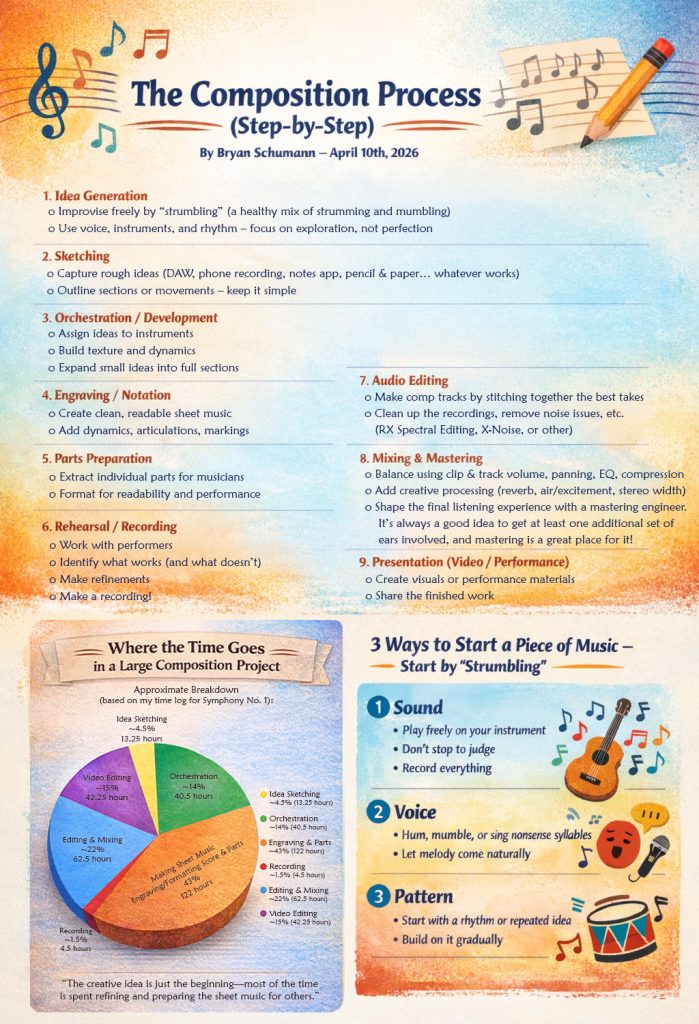
When I started writing my first symphony, I didn’t begin with a grand plan or a perfectly mapped-out structure. I started the same way I start almost everything—by sitting at the piano (or guitar) and “strumbling,” a word I made up that combines strumming and mumbling. Even without lyrics, that loose, unfiltered mix of instrumental and vocal improvisation helps me discover ideas and melodies without overthinking them. What surprised me most is that this same playful, imperfect process worked just as well for a full symphony as it has for songwriting.
In the first week, I sketched all five movements at the piano. Nothing super polished—just rough ideas, textures, and directions. From there, the real fun began. Having already recorded the piano MIDI notes into my DAW of choice, I moved into orchestration, which for me often meant assigning those MIDI notes to different sections of the orchestra moment by moment. This was one of the most enjoyable parts of the process—like adding color to a sketch drawing. After that came weeks of refining, engraving sheet music, and preparing parts, before eventually recording both audio and video with real musicians.
See the full video recording of the Czech National Symphony Orchestra and download the score here.
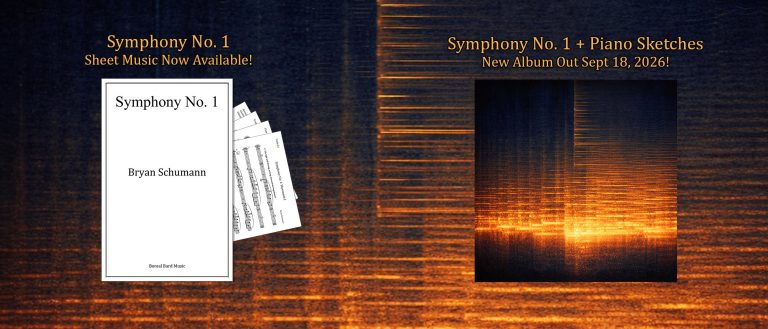
One of the biggest lessons/reminders for me was in realizing that composing isn’t just about writing notes—most of my time was actually spent generating, organizing, and preparing the sheet music so that other people could bring it to life.
Another important realization was how much of the process is refinement. The initial ideas came together quickly, but the majority of my time was spent editing, adjusting, and solving problems. That included everything from reworking large sections and improving transitions to fixing small details in the score and parts. Even after recording, there was still more work—weeks spent editing audio, mixing, and mastering to get everything to feel cohesive, as well as many more days editing video. It’s easy for students and listeners to think music creation is simply about inspiration, but in reality, it’s just as much about patience, refinement, and iteration.
For anyone looking to create music (or any creative work), I think following a process like the one I’ve outlined in the supplemental PDF can be incredibly freeing. You don’t need to start with a perfect idea—you just need to start. Improvising, experimenting, and even making something messy is often the best way forward. Whether it’s a short piece or a larger work, breaking the process into stages—idea, sketch, refine—makes it much more approachable. It also helps you see that creativity isn’t one big moment, but a series of smaller steps that sometimes aren’t always linear. Often, circling back to an earlier stage and removing material can be just as valuable as the sessions where you created it.
Writing this symphony reminded me that making music is both creative and practical. It’s about expression, and also about craft—and most importantly, it’s something that grows over time.
I’m based in Minnesota and always enjoy connecting with students and educators—whether that’s sharing this process or working with classrooms directly. If there’s one thing I’d encourage, it’s this: start before you feel ready, stay curious, and let the process unfold.
Bryan Schumann is a Minnesota-based composer, producer, singer-songwriter, and multi-instrumentalist whose work spans orchestral, chamber, wind band, film, video game, and solo piano repertoire. His music is known for its lyrical melodies, rich orchestration, and contemporary classical influences.
His latest work, Symphony No. 1, was created with support from a Fiscal Year 2026 Creative Individuals grant from the Minnesota State Arts Board and recorded by the Czech National Symphony Orchestra. His music has been performed by ensembles and musicians in the United States and abroad.
Schumann is also the singer-songwriter behind the indie-folk-pop group The Sunshapes and the creator of the ambient music project Ambient Embrace.
Free Poster Download
Enter your information for a free poster download about symphonies and composition!